Mobile messaging technology stands at a pivotal crossroads. For over three decades, SMS has dominated as the universal text messaging protocol, but RCS (Rich Communication Services) is rapidly transforming how billions of people communicate on their smartphones. This comprehensive comparison examines RCS vs SMS across critical dimensions—features, security, compatibility, business applications, and adoption trajectories—to help you understand which messaging standard best serves your needs in 2025 and beyond.
What Is SMS Messaging and Why It Still Matters
SMS, or Short Message Service, represents the foundational text messaging protocol that launched in 1992 and became globally ubiquitous throughout the 2000s. Operating exclusively over cellular networks, SMS transmits short text messages between mobile devices without requiring internet connectivity.
Core SMS specifications include:
160-character message limit — Messages exceeding this length split into multiple segments, each billed separately by carriers.
Universal device compatibility — Every mobile phone manufactured in the past 30 years, from basic feature phones to modern smartphones, supports SMS natively.
Cellular-only transmission — SMS routes through carrier signaling channels (SS7 protocol), functioning independently of data connections or Wi-Fi networks.
Text-exclusive format — Pure SMS handles only plain text; multimedia content requires the separate MMS (Multimedia Messaging Service) protocol.
Near-instantaneous delivery — Under normal network conditions, SMS messages typically deliver within seconds.
Despite its technical limitations, SMS maintains dominant market positions in critical applications: two-factor authentication (2FA), emergency alerts, banking notifications, appointment reminders, and communications in areas with limited internet infrastructure. According to industry data, over 23 billion SMS messages are sent daily in the United States alone, demonstrating the protocol’s enduring relevance.
What Is RCS Messaging and How Does It Work?
Rich Communication Services (RCS) functions as the next-generation messaging protocol designed to supersede SMS while maintaining backward compatibility. Developed by the GSM Association (GSMA) and actively promoted by Google since 2015, RCS transforms basic texting into an internet-powered communication platform rivaling standalone messaging apps.
RCS messaging architecture delivers:
High-fidelity media sharing — Send full-resolution photos (up to 105MB), 4K videos, audio files, location data, and contact cards without compression or quality degradation.
Real-time conversation indicators — See when contacts are typing, when messages are delivered, and when they’re read—features previously exclusive to apps like iMessage and WhatsApp.
Enhanced group messaging — Create groups with up to 100 participants, add/remove members dynamically, name conversations, and share administrative controls.
Internet-based transmission — RCS routes messages through mobile data or Wi-Fi connections using the Internet Protocol (IP), enabling functionality beyond cellular network limitations.
Interactive business messaging — Brands can send verified messages with clickable buttons, product carousels, appointment schedulers, and secure payment integrations directly within the messaging interface.
Automatic fallback to SMS — When RCS connectivity is unavailable or the recipient doesn’t support RCS, messages automatically downgrade to SMS, ensuring delivery continuity.
Major carriers including Verizon, AT&T, and T-Mobile in the United States have deployed RCS infrastructure, with Google Messages serving as the primary RCS client for Android devices. Apple announced RCS support integration in iOS 18, released in September 2024, marking a watershed moment for cross-platform RCS adoption.
RCS vs SMS: Critical Feature Comparisons
Message Capabilities and User Experience
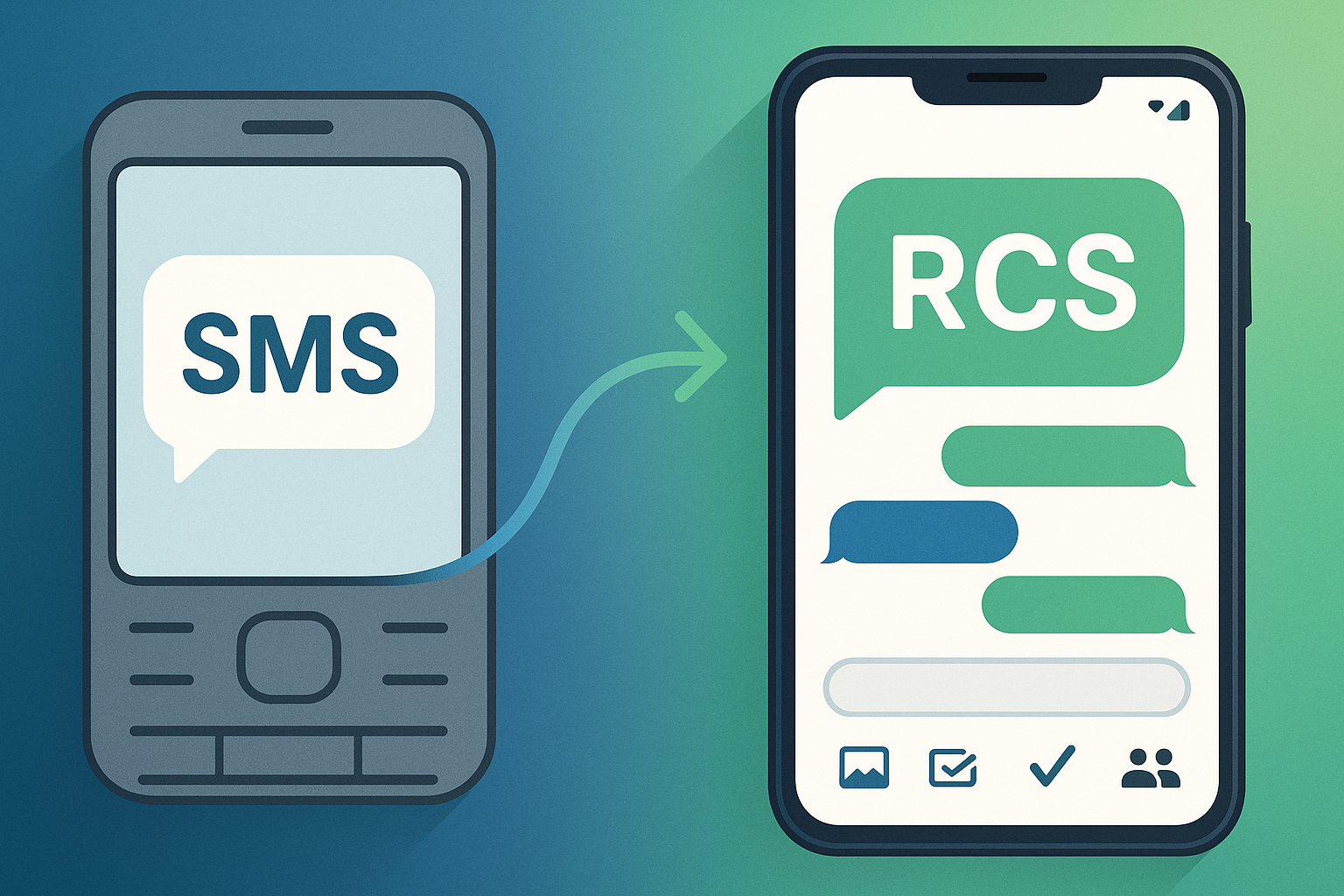
The most immediately noticeable difference between SMS vs RCS lies in communication richness.
SMS capabilities:
- Plain text messages only (160 characters per segment)
- MMS required for images, which compresses media to approximately 300KB
- No read receipts or typing indicators
- Basic group messaging with limited functionality
- No message reactions or interactive elements
RCS capabilities:
- Rich text with formatting options
- HD photos and videos up to 105MB without compression
- Real-time typing indicators and read receipts
- Advanced group chats with participant management
- Message reactions (emoji responses), message editing, and scheduling
- File sharing (PDFs, spreadsheets, presentations)
- Location sharing with interactive maps
This feature disparity makes RCS messaging more comparable to WhatsApp, Telegram, or iMessage than to traditional SMS texting.
Connectivity Requirements and Reliability
Transmission methods represent a fundamental technical difference in the RCS message vs SMS debate.
SMS connectivity:
- Operates exclusively on cellular networks via SS7 signaling
- Functions with minimal signal strength
- No internet connection required
- Highly reliable even in congested networks
- Works during data outages or when Wi-Fi is unavailable
RCS connectivity:
- Requires active internet connection (mobile data or Wi-Fi)
- Dependent on carrier RCS infrastructure deployment
- May experience delays with poor internet connectivity
- Automatically falls back to SMS when RCS unavailable
- Enables messaging from tablets or computers through connected devices
For users in rural areas or regions with inconsistent data coverage, SMS maintains critical advantages in reliability. However, RCS provides greater flexibility for users with strong internet connectivity, especially when traveling internationally where cellular roaming is expensive but Wi-Fi is available.
Security, Privacy, and Encryption Standards
Security considerations have become increasingly important as messaging handles sensitive personal and financial information.
SMS security profile:
- No encryption by default—messages transmit as plain text
- Vulnerable to SS7 protocol exploits and SIM swapping attacks
- Accessible to carriers and potentially government agencies
- Susceptible to interception during transmission
- Not recommended for sensitive communications
The lack of SMS encryption has led to documented security breaches, particularly in 2FA systems where attackers intercept verification codes.
RCS security profile:
- End-to-end encryption (E2EE) available in Google Messages for one-on-one conversations
- E2EE not universally implemented across all RCS providers
- Security standards vary by carrier implementation
- Messages encrypted in transit on IP networks
- Continuous security improvements as protocol matures
Google implemented universal RCS end-to-end encryption in Google Messages in late 2023, significantly improving privacy compared to SMS. However, RCS group chats and business messages currently lack E2EE, representing a limitation compared to fully encrypted platforms like Signal or WhatsApp.
Device and Platform Compatibility
Compatibility determines whether users can actually benefit from advanced messaging features.
SMS compatibility:
- Supported on 100% of mobile devices globally
- Works across all carriers without special configuration
- No app or software updates required
- Functions on feature phones and smartphones equally
- No vendor lock-in or platform dependencies
RCS compatibility:
- Available primarily on Android smartphones (2020 models and newer)
- Requires carrier support and RCS-enabled messaging app
- Apple iOS 18+ devices support RCS (iPhone XS and newer)
- Inconsistent availability across international carriers
- May require specific app (typically Google Messages on Android)
According to mobile analytics, approximately 800 million active RCS users exist globally as of early 2025, compared to over 6 billion SMS users. This compatibility gap explains why SMS remains the universal fallback standard.
Text Message RCS vs SMS: Business Communication and Marketing
Commercial messaging represents a multi-billion dollar industry, with businesses choosing between SMS and RCS based on campaign objectives and customer engagement strategies.
SMS in Business Communications
Businesses continue investing heavily in SMS marketing and communications due to several compelling advantages:
98% open rate — SMS messages are opened within 3 minutes on average, far exceeding email open rates (approximately 20%).
Universal customer reach — Every mobile subscriber can receive SMS without requiring app downloads or account creation.
Proven reliability — SMS delivery rates exceed 95% in developed markets.
Regulatory compliance — Well-established legal frameworks (TCPA in the USA) govern SMS marketing practices.
Critical notifications — Banks, airlines, healthcare providers, and utilities rely on SMS for time-sensitive alerts including account alerts, boarding passes, prescription notifications, and outage updates.
Cost-effectiveness — SMS campaigns typically cost $0.01-$0.05 per message depending on volume.
SMS remains the gold standard for transactional messaging—order confirmations, delivery updates, appointment reminders, and verification codes—where reliability trumps visual appeal.
RCS in Business Communications
RCS transforms commercial messaging from simple notifications into interactive brand experiences:
Verified business identity — Messages display verified sender badges, business logos, and brand colors, reducing phishing risks and increasing customer trust by up to 35%.
Interactive message elements — Embed clickable buttons (website links, phone calls, directions), product carousels with swipeable images, appointment schedulers, and location finders directly in conversations.
Rich media campaigns — Send high-resolution product photos, promotional videos, animated GIFs, and branded imagery without compression.
Engagement analytics — Track message delivery, read rates, click-through rates on buttons, and conversion metrics in real-time.
Conversational commerce — Enable customers to browse catalogs, add items to cart, and complete purchases without leaving the messaging app.
Customer service automation — Deploy chatbots with natural language processing to handle common inquiries, route complex issues, and provide 24/7 support.
Early RCS adoption data from brands like Subway, Booking.com, and 1-800-Flowers shows conversion rate improvements of 8-15x compared to traditional SMS campaigns. However, RCS business messaging costs range from $0.03-$0.10 per message, representing a significant premium over SMS.
Key Advantages: Why RCS Beats SMS
RCS represents a generational leap forward in messaging technology, delivering benefits that justify its growing adoption.
Dramatically Superior User Experience
Modern smartphone users expect messaging to include typing indicators, read receipts, high-quality media, and expressive reactions—features absent from SMS. RCS delivers these expectations, eliminating the jarring experience of downgrading to SMS when texting non-iPhone users from Android devices.
Multimedia Without Compromise
SMS users depend on MMS for photos and videos, which compresses 12-megapixel photos to roughly 300KB, resulting in grainy, pixelated images. RCS maintains full image quality and supports 4K video sharing, critical for users who rely on messaging for visual communication.
Future-Proof Protocol
As 5G networks expand and internet connectivity becomes ubiquitous, internet-based messaging protocols like RCS naturally benefit from increased bandwidth and reduced latency. SMS, constrained by decades-old cellular architecture, cannot evolve to leverage modern network capabilities.
Seamless Wi-Fi Messaging
International travelers benefit significantly from RCS’s Wi-Fi support. Rather than incurring expensive international SMS fees (often $0.50+ per message), RCS messages route through hotel or airport Wi-Fi at no additional cost.
Unified Cross-Platform Communication
With Apple’s iOS 18 RCS integration, Android and iPhone users can finally enjoy feature-rich conversations without platform fragmentation. This eliminates the notorious “green bubble” stigma and technical limitations that previously hampered Android-iOS communication.
Key Advantages: Why SMS Still Wins
Despite RCS momentum, SMS maintains critical advantages that ensure its continued relevance.
Absolute Universal Compatibility
SMS works on literally every mobile device worldwide, from smartphones to basic feature phones used by billions in developing markets. This universality makes SMS indispensable for critical communications reaching entire populations.
Unmatched Reliability
SMS operates independently of internet connectivity, functioning in scenarios where RCS fails: during data outages, in areas with congested networks, in remote locations with cellular but no broadband infrastructure, and during natural disasters when internet services collapse.
Zero Configuration Required
SMS requires no setup, app installation, account creation, or settings adjustment. It works out-of-the-box on every device, eliminating technical barriers for less tech-savvy users.
Lower Infrastructure Costs
For businesses and carriers, SMS infrastructure is fully depreciated and incredibly cost-efficient to operate. RCS requires substantial ongoing investment in IP-based messaging infrastructure, data centers, and continuous protocol updates.
Critical Emergency Communications
Government emergency alert systems, Amber Alerts, and public safety notifications rely on SMS because it guarantees message delivery regardless of device type or internet availability. RCS cannot match this reliability for life-critical communications.
Major Challenges Slowing RCS Adoption
Despite its technical superiority, RCS faces significant barriers preventing rapid SMS replacement.
Fragmented Global Carrier Support
While major US carriers support RCS, international availability remains inconsistent. Many European, Asian, and developing market carriers have delayed or declined RCS implementation, limiting international RCS messaging.
Incomplete End-to-End Encryption
Unlike Signal, WhatsApp, or iMessage, RCS E2EE only works for one-on-one conversations in specific apps (primarily Google Messages). Group chats and business messages lack encryption, creating security gaps for privacy-conscious users.
User Awareness Gap
Most smartphone users don’t understand the difference between RCS and SMS, often unaware their messages are using advanced features. This lack of awareness slows conscious adoption and feature utilization.
Apple’s Late Integration
Apple’s resistance to RCS until late 2024 created a massive compatibility gap. While iOS 18+ now supports RCS, millions of older iPhones remain in use, fragmenting the iPhone user base and limiting RCS availability for Android users texting iPhone contacts.
Competing Messaging Apps
WhatsApp (2 billion users), Telegram (800 million users), and other OTT (over-the-top) messaging apps already provide RCS-like features with better encryption and cross-platform support. Users already invested in these ecosystems have limited incentive to switch to RCS.
The Future of Messaging: Will RCS Replace SMS?
Industry analysis suggests RCS will gradually become the dominant native messaging protocol, but SMS will persist as a critical fallback for decades.
Near-Term Trends (2025-2027)
Accelerated iPhone adoption — Apple’s iOS 18 RCS support will dramatically increase RCS penetration in the United States, where iPhones represent approximately 60% of smartphone market share.
Business messaging expansion — Enterprises will increasingly deploy RCS for customer engagement as conversion data validates ROI improvements over SMS.
Enhanced security standards — Universal E2EE for RCS group chats and business messages will roll out, addressing current privacy limitations.
5G network synergy — As 5G coverage expands, RCS will benefit from ultra-low latency and high bandwidth, enabling new real-time communication features.
Long-Term Evolution (2028-2030+)
AI integration — RCS will likely incorporate AI assistants, real-time translation, automated scheduling, and smart reply suggestions directly in the messaging protocol.
Rich media evolution — Expect support for AR/VR content, interactive 3D models, and immersive brand experiences within RCS conversations.
SMS as legacy fallback — SMS will transition to a reliability backup, similar to how 2G networks persist for basic connectivity despite 5G deployment.
Global standardization — International regulatory pressure and competitive dynamics will push holdout carriers toward RCS implementation.
However, SMS will remain essential for:
- Emergency communications and public safety alerts
- Basic feature phone users in developing markets
- Regions with unreliable internet infrastructure
- Backup communication when internet services fail
- Legacy system integrations in enterprises
Frequently Asked Questions
Is RCS messaging the same as SMS?
No, RCS and SMS are fundamentally different protocols. SMS sends text-only messages over cellular networks, while RCS sends rich media (photos, videos, files) over internet connections with features like read receipts and typing indicators. RCS automatically falls back to SMS when internet connectivity or RCS support is unavailable.
Do I need a special app to use RCS messaging?
On Android devices, Google Messages typically provides RCS functionality, though Samsung Messages and some carrier apps also support RCS. On iPhone (iOS 18+), RCS works through the default Messages app. Most modern smartphones come with RCS-capable messaging apps pre-installed.
Is RCS more secure than SMS?
Yes, when end-to-end encryption is enabled. Google Messages provides E2EE for one-on-one RCS conversations, making them significantly more secure than unencrypted SMS. However, RCS group chats and business messages currently lack E2EE, creating security gaps compared to fully encrypted platforms.
Will I be charged extra for RCS messages?
No, RCS messages use your data plan (like browsing the web or using apps) rather than SMS/MMS allowances. If you have unlimited data, RCS costs nothing extra. When RCS is unavailable and messages fall back to SMS, standard SMS charges may apply if you don’t have unlimited texting.
Can iPhone users send RCS messages to Android users?
Yes, as of iOS 18 (released September 2024), iPhones support RCS messaging. iPhone users with iOS 18+ can now send and receive RCS messages with Android users, including features like read receipts, typing indicators, and high-quality media sharing. However, conversations still appear as green bubbles rather than blue iMessage bubbles.
Conclusion: Understanding the SMS vs RCS Transition
The evolution from SMS to RCS represents more than a simple protocol upgrade—it marks a fundamental shift in how mobile messaging operates. SMS, built on 1990s cellular technology, excels at universal compatibility, reliability, and simplicity. RCS, powered by modern internet infrastructure, delivers the rich features, media quality, and interactivity users expect from contemporary communication tools.
For consumers, the choice isn’t binary. Your smartphone automatically uses RCS when available and seamlessly falls back to SMS when necessary, providing the best available experience without manual intervention.
For businesses, the decision requires strategic evaluation. SMS remains unmatched for critical notifications, broad audience reach, and cost-efficiency. RCS delivers superior engagement, conversion rates, and customer experience for brands targeting smartphone users with marketing and support communications.
As RCS adoption accelerates through 2025 and beyond—driven by Apple’s integration, carrier expansion, and business investment—expect RCS to handle the majority of person-to-person and business-to-consumer messaging. Yet SMS will endure as the universal backup, ensuring communication continuity when modern technology fails or reaches its limits.
Understanding both protocols empowers you to leverage the right messaging tool for each situation, maximizing reliability, security, and communication effectiveness.
5 FAQ Questions Based on People Also Ask:
- Is RCS messaging the same as SMS?
- Do I need a special app to use RCS messaging?
- Is RCS more secure than SMS?
- Will I be charged extra for RCS messages?
- Can iPhone users send RCS messages to Android users?