
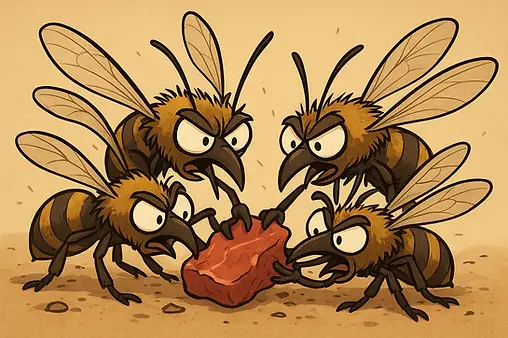
Most people picture bees hovering over flowers, but one rare group of stingless bees from Central and South America has taken a radically different path. Vulture bees — named for their scavenging behavior — feed primarily on carrion rather than pollen, making them the only known bees on Earth with a meat-based diet. Their specialized gut bacteria, fermentation chambers, and still-functional honey production make them one of the most scientifically significant insects ever studied.
What Are Vulture Bees?
Vulture bees are a small cluster of stingless bee species within the tribe Meliponini, native to tropical rainforests across Central and South America. Unlike virtually every other bee species, which depend entirely on flowering plants for protein, vulture bees have evolved to harvest animal flesh as their primary protein source.
The three species most closely studied by researchers — Trigona hypogea, Trigona necrophaga, and Trigona crassipes — were documented consuming carrion as far back as the 1980s, but it was a landmark 2021 study published in mBio that revealed just how dramatically their gut microbiome had changed compared to other bees. That study found their intestinal bacteria closely resemble those found in hyenas and vultures — highly specialized scavengers — rather than the bacteria of pollen-collecting bees.
Why Are They Called Vulture Bees?
The name is straightforward: like the vultures of the sky, these bees locate and consume decaying animal carcasses. Field researchers have documented vulture bees swarming over the bodies of small lizards, birds, frogs, and mammals. Unlike flies, which lay eggs in carrion, vulture bees actively cut and transport meat back to the colony for fermentation and storage.
Their recruitment behavior is also notable. Once a scout locates a food source, it uses chemical signals — pheromone trails — to guide colony mates to the carcass. Dozens of workers can strip a small animal within hours.
How Do Vulture Bees Eat and Process Meat?
Bees are anatomically designed to consume liquids, so harvesting solid flesh requires a workaround. Vulture bees address this by transporting small pieces of meat back to dedicated fermentation pots within the nest. Inside those sealed chambers, a colony of specialized microbes breaks down the protein into digestible compounds over a period of days.
The 2021 mBio study identified Lactobacillus and Carnobacterium species — bacteria typically associated with fermenting meat — thriving in the vulture bee gut. Remarkably, these bees also showed reduced populations of the pollen-processing bacteria found in standard honeybees, confirming that their digestive system has genuinely rewired itself for a carnivorous diet over evolutionary time.
Comparison: Vulture Bee Gut vs. Standard Bee Gut
- Vulture bee: Rich in Lactobacillus, Carnobacterium, and acidophilic bacteria adapted to animal protein and pathogens found in rotting flesh.
- Standard honeybee: Dominated by Snodgrassella alvi and Gilliamella apicola — bacteria optimized for breaking down pollen and plant sugars.
- Shared trait: Both maintain highly structured, colony-specific microbiomes that are passed between generations inside the nest.
The Vulture Bee Hive: Structure and Organization
A vulture bee hive is built inside hollow trees, underground cavities, or abandoned termite mounds. Workers construct the internal architecture from a mixture of wax and plant resins — the same basic building material used by other stingless bees — but the layout includes a feature unique to vulture bees: sealed meat fermentation chambers separate from food storage and brood areas.
This physical separation is not incidental. Rotting meat harbors Clostridium, Salmonella, and other pathogens that could devastate a colony if they spread to developing larvae. By sealing fermented meat in isolated pots and allowing specific microbes to dominate the environment, the bees effectively create a controlled bioreactor inside their own home.
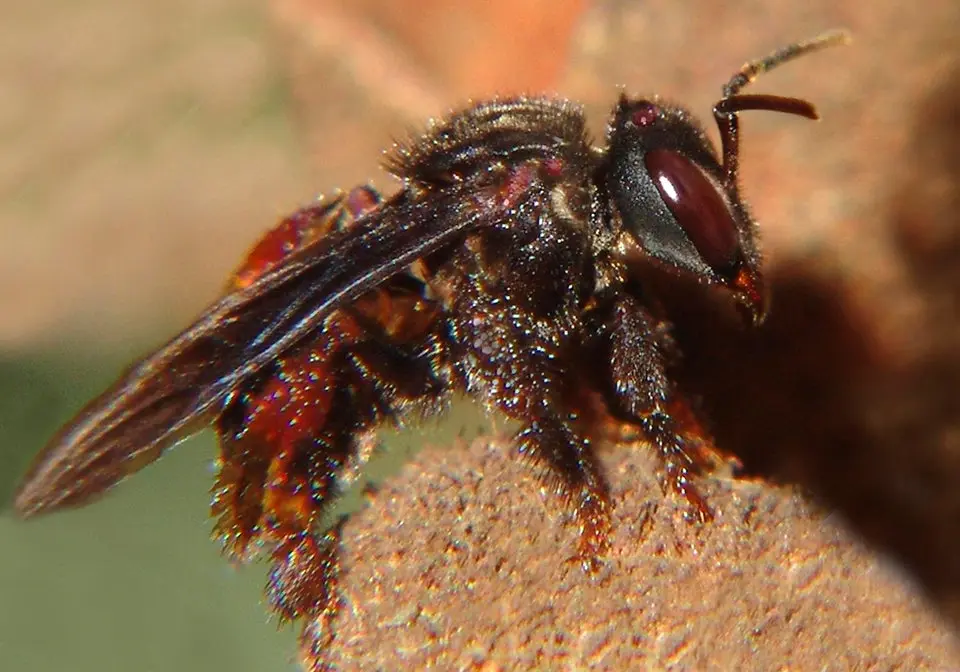
Key Zones Inside a Vulture Bee Hive
- Brood core: Central cluster of wax cells where the queen lays eggs and larvae develop. Kept at stable temperature and protected from contamination.
- Honey and nectar pots: Elongated wax containers filled with processed nectar. These are nutritionally separate from the protein stores.
- Meat fermentation pots: Sealed chambers where raw carrion is deposited and left to ferment over several days before being consumed by workers and larvae.
- Resin-hardened entrance: A narrow, sticky gateway that deters ants, beetles, and other nest invaders. Some species deploy additional guard bees at the entrance.
The Vulture Bee Nest: Location, Construction, and Defense
Vulture bee nests are frequently found in lowland tropical forests with high biodiversity — environments where animal carcasses are available year-round. Colonies prefer pre-existing cavities that minimize construction effort and provide insulation. Nest populations vary but can include several thousand workers in mature colonies.
Because these bees lack stingers — a universal trait among Meliponini — they rely on alternative defenses. Workers will bite aggressively when the nest is disturbed. Several species produce a caustic propolis blend that adheres to the legs and mouthparts of intruding insects, effectively immobilizing smaller threats. A few species have been documented releasing sticky resin strings at the entrance to trap ants.
Does the Vulture Bee Produce Honey?
Yes — and this is one of the most common misconceptions worth clarifying. Vulture bees do produce honey. The meat they collect provides protein for the colony, but carbohydrates still come from nectar, which is processed into honey just as in other stingless bee species.
Vulture bee honey tends to be darker in color, richer in flavor, and more complex in its aromatic compounds than standard commercial honey, owing partly to the bees’ broader foraging range across tropical plant species. However, production per colony is far smaller than in managed honeybee hives, and vulture bee honey is not commercially harvested at scale. It remains a subject of scientific curiosity rather than a market product.
It is worth emphasizing: the carrion itself does not become honey. Fermented meat becomes protein feed for adults and larvae. The honey supply chain — nectar in, enzymatically processed honey out — remains biochemically distinct.
Ecological Role of Vulture Bees in Tropical Ecosystems
Vulture bees occupy an ecological niche occupied by almost no other pollinator. As scavengers, they accelerate the breakdown of small animal carcasses, returning nutrients to the soil faster than decomposition alone would. In dense rainforest ecosystems where nutrient cycling is critical, this contribution — while modest in scale — is ecologically meaningful.
Because vulture bees still visit flowers for nectar, they also function as pollinators for a range of tropical plant species. This dual role — scavenger and pollinator — means their disappearance from an ecosystem would remove both a decomposition agent and a reproductive service for flowering plants simultaneously.
Climate change and deforestation in Central and South America represent genuine long-term threats to vulture bee populations. As tropical forest cover declines, both their nesting sites and their carrion food sources become less predictable.
Vulture Bees vs. Regular Bees: Key Differences at a Glance
| Feature | Vulture Bee | Honeybee / Standard Stingless Bee |
| Primary protein source | Carrion (decomposing animal flesh) | Pollen from flowering plants |
| Gut microbiome | Lactobacillus, Carnobacterium (meat-adapted) | Snodgrassella, Gilliamella (pollen-adapted) |
| Foraging cue | Scent of decaying flesh | Flower color, scent, UV patterns |
| Stinger | Absent (stingless bee) | Present in honeybees; absent in most stingless bees |
| Honey production | Yes, from nectar; small quantity | Yes, from nectar; large quantity in honeybees |
| Hive feature | Sealed meat fermentation pots | No meat chambers; standard pollen baskets |
| Defense mechanism | Biting, resin traps, guard bees | Stinging (honeybees); biting and resin (stingless) |
Are Vulture Bees Dangerous to Humans?
No. Vulture bees pose no meaningful threat to humans. They do not attack living animals in search of food. As stingless bees, they cannot inflict the kind of sting associated with honeybees or wasps. Their defense is limited to biting, which may cause minor irritation at most.Their preference for humid tropical forests also means that most people in the continental United States will never encounter a vulture bee in the wild. Researchers working with colonies handle them with minimal protective equipment.
Scientific Importance: What Vulture Bees Tell Us About Evolution
The study of vulture bees has opened productive lines of inquiry in microbiology, evolutionary biology, and food science. Researchers are particularly interested in two questions.First: how did these bees evolve a gut microbiome capable of processing pathogen-laden meat without killing the colony? The acid-tolerant, meat-specialized bacteria in their digestive systems appear to actively suppress dangerous microorganisms, offering a potential model for understanding microbial immunity in social insects — and possibly informing research into food preservation.Second: the transition from plant-based to animal-based protein represents one of the most dramatic dietary shifts ever documented in a pollinating insect. Mapping the genomic changes that enabled this shift may reveal broader principles about how gut microbiomes and host evolution co-evolve over time.The 2021 mBio study — led by researchers from UC Riverside, the University of Massachusetts, and colleagues across North and South America — stands as the most comprehensive analysis of vulture bee gut bacteria to date and is frequently cited in entomology and microbiome research.
Frequently Asked Questions
What do vulture bees eat?
Vulture bees eat primarily carrion — the flesh of dead animals — as their protein source. Unlike all other known bee species, which rely on pollen for protein, vulture bees have evolved to harvest and ferment meat inside their nests. They supplement this protein diet with nectar from flowers, which they process into honey.
Is vulture bee honey safe to eat?
Vulture bee honey is produced from nectar, not from meat, and is chemically distinct from the fermented protein stores in the hive. There is no scientific evidence suggesting it is unsafe. However, it is not commercially available, and no large-scale safety studies have been conducted. Researchers who have tasted it describe it as darker and more complex than standard honey.
Where do vulture bees live?
Vulture bees are native to tropical rainforests in Central and South America, with the highest species diversity found in countries such as Brazil, Costa Rica, and Panama. They nest inside hollow trees, underground cavities, and abandoned termite mounds. They have not been documented in North America.
Do vulture bees sting?
No. Vulture bees are members of the stingless bee tribe Meliponini and lack functional stingers. When threatened, they defend themselves by biting and by deploying sticky resin substances at the nest entrance. A vulture bee bite may cause mild irritation but is not dangerous.
How are vulture bee nests different from honeybee hives?
The most distinctive structural difference is the presence of dedicated meat fermentation pots — sealed wax chambers where collected carrion is left to ferment before consumption. Standard honeybee hives contain only brood cells, wax comb for honey, and pollen storage. Vulture bee hives also use a wax-resin composite rather than pure beeswax, and their entrances are typically reinforced with propolis to deter ant intrusions.